
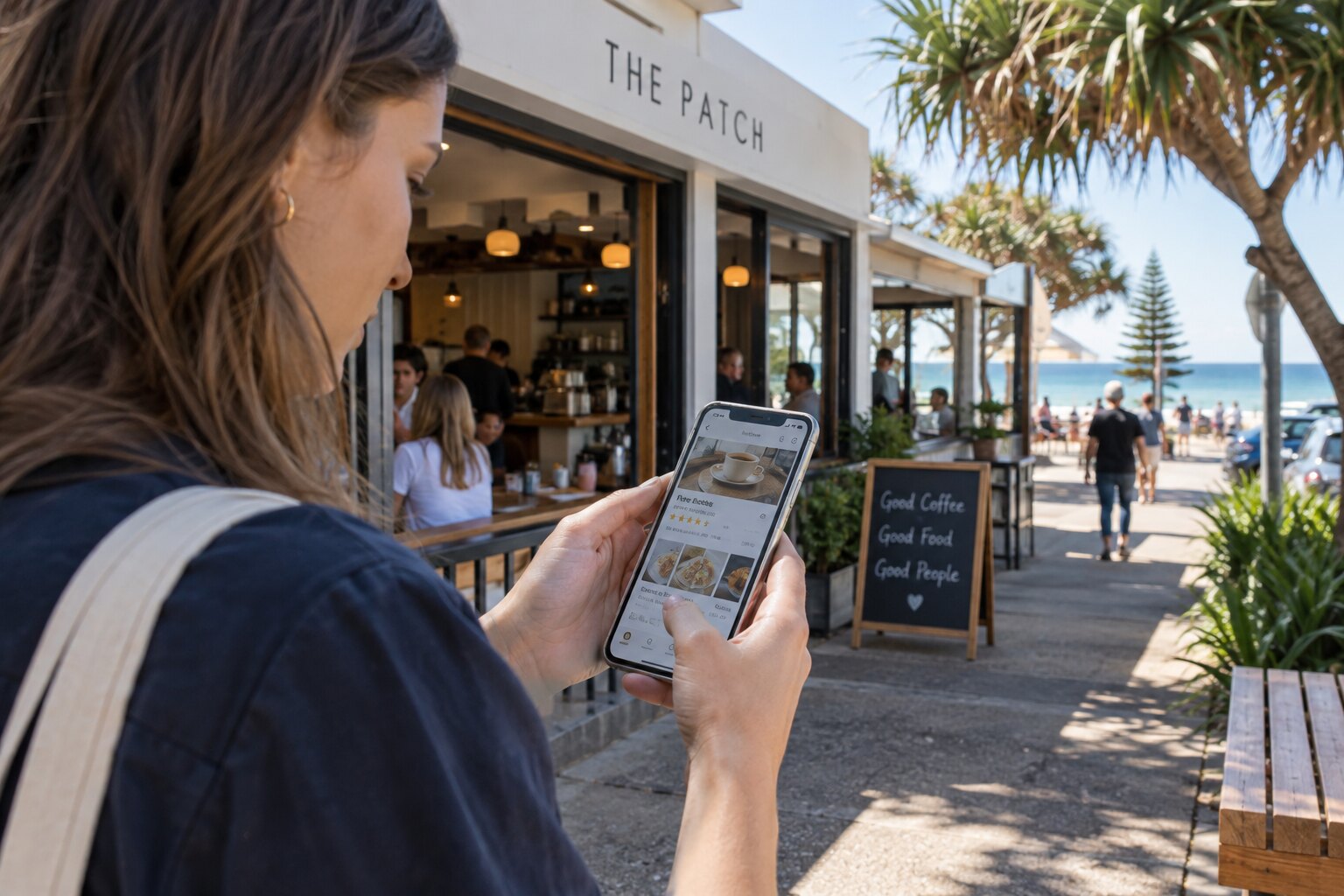
AI-generated editorial image; illustrative scene, not a client project or verified performance report.
The Sunshine Coast is not one uniform market. A customer in Nambour, Noosa, Caloundra or Buderim may use different wording, expect different travel ranges and choose between a different set of competitors. Local SEO helps a business show search engines and customers the places it genuinely serves.
That does not mean forcing a suburb into every sentence. It means making the business’s location, service area, experience and offer consistent across the places people check.
Local search begins with intent
Someone searching “SEO Nambour” or “web designer near me” is not asking for a definition. They are looking for a provider they can evaluate. The page needs to answer practical questions quickly: Is the business local? Does it provide the service? Who will do the work? Is there credible experience? What happens next?
Local relevance works best when it reduces uncertainty for a customer—not when it simply repeats a place name.
Keep the Google Business Profile accurate
Use the real business name, the fewest accurate categories, a correct phone number, current website, relevant services and honest hours. If the business operates from a residential address and customers are not served there, Google’s guidance is to hide that address and use a service area.
Photos, updates and review responses can show that the business is active, but they cannot compensate for a misleading name, virtual office or inconsistent contact details.
Make the website confirm the profile
The website should clearly display the business name, Nambour or Sunshine Coast base, service area, phone and contact method. The About page should identify the real operator. The service pages should describe work the business actually provides.
Structured data can reinforce those facts in machine-readable form, but it must match the visible content. Marking up an address or review that is not shown accurately on the website is not a shortcut.
Create location pages only when they are useful
A dedicated Nambour page makes sense for a Nambour-based business because it can explain the local connection, nearby service areas and how the service works in that market. A Noosa page may also make sense if the business has specific experience, examples or logistics there.
What does not help is changing “Nambour” to “Noosa” across the same long page and publishing both. Those pages give customers little value and can divide the site’s relevance across several weak URLs.
Reviews are evidence, not decoration
Ask real customers for honest reviews after the service. Do not script a review full of target keywords or create names and outcomes to make the website look busier. Respond calmly and specifically, including when feedback is critical.
On the website, publish a testimonial only when it is genuine and you have permission. A factual case study can be stronger: describe the starting situation, work completed, dates, source of the measurements and limits of the result.
Local citations still need consistency
Directory listings are not a numbers contest. Focus on major, relevant and legitimate sources. Keep the business name, phone, website and service-area treatment consistent. Old domains, duplicate profiles and conflicting numbers create confusion for both customers and platforms.
Connect local SEO to the customer journey
A local ranking is not the final result. The landing page still needs a fast mobile experience, a tap-friendly phone number, a concise contact form and a clear explanation of the next step. Track the quality of enquiries, not only the number of impressions.
- Does the visitor land on the service they searched for?
- Can they confirm the location and service area immediately?
- Is the person or business behind the site identifiable?
- Can they call or send the right information without friction?
- Does the provider respond while the enquiry is still warm?
A sensible 90-day local SEO plan
Weeks 1–2: establish the baseline
Review the Google Business Profile, website contact details, important landing pages, Search Console queries, index coverage, reviews, citations and conversion tracking.
Weeks 3–6: repair the foundation
Fix technical issues, align the profile and website, improve the main local service pages, remove or redirect duplicate location content and make the contact path work on mobile.
Weeks 7–12: build real local proof
Add approved project examples, request reviews through a consistent process, publish genuinely helpful local content and strengthen internal links. Compare enquiries and Search Console performance with the recorded baseline.
Give local customers an answer they can use.
Imagine a customer checking whether you serve their address. “We cover the Sunshine Coast” may be a starting point, but they may also need to know which service is available, whether travel affects the quote and how to confirm availability. Explain the real process and any boundaries that matter. Do not invent a local office or imply a service is available simply to include another place name.
A useful local page can show an approved project example, explain how enquiries are handled and link to the detailed service information. That gives it a purpose beyond repeating the homepage. If there is nothing distinct to explain, improving the main regional service page may be more useful than creating another location URL.
Read about working with a Nambour web design and SEO specialist, or explore Sunshine Coast SEO support to apply this approach to your business.