
One-page website design
One-page website design for Sunshine Coast businesses
When customers need to know what you do, where to find you and how to book, a well-planned page can answer all three. I’ll help you decide what earns its place and build a website you can keep current.
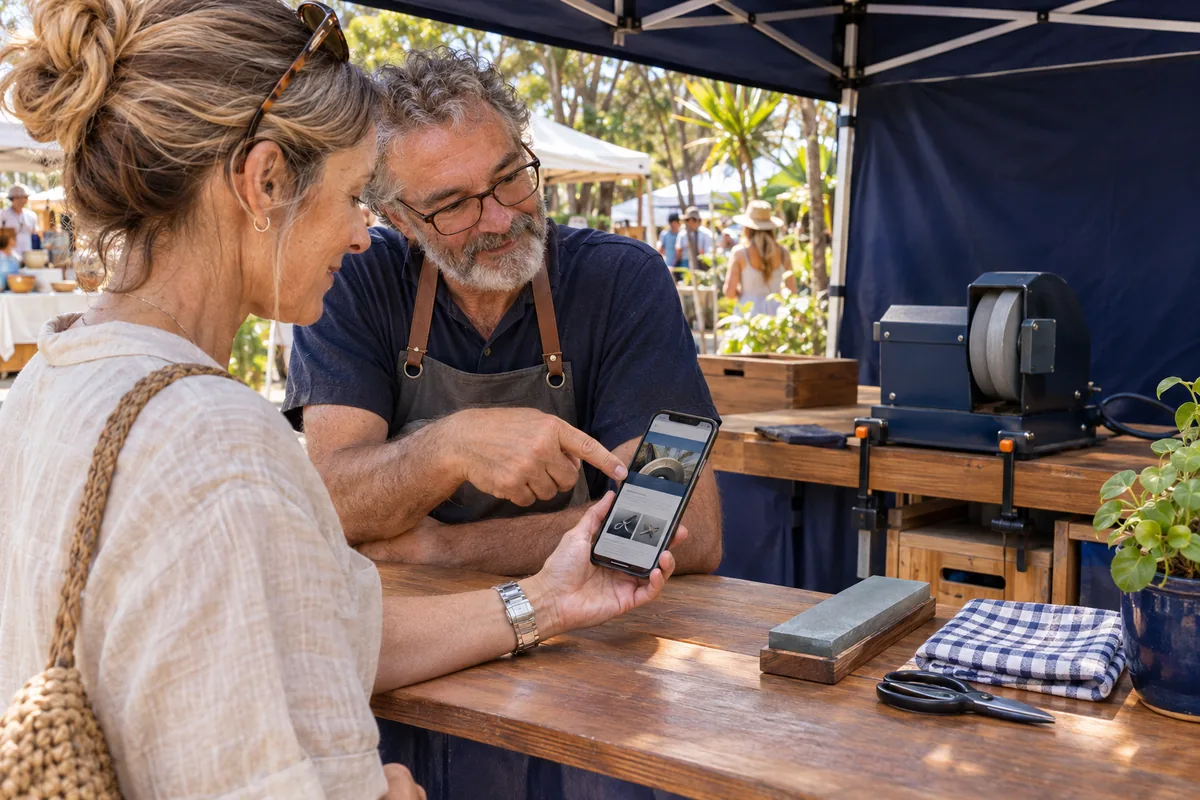
When does a one-page website earn its keep?
Think about the last person a customer referred to you. What did they need to know before they got in touch? If you could answer them in a short conversation about one service, a single-page business website can do the same job. It gives a referral, a Google search or a scan of your business card somewhere useful to land.
I design one-page websites from Nambour for Sunshine Coast sole traders and small businesses. Before I sketch the layout, I ask what you offer, where someone can get it and what happens when they enquire. A music tutor taking trial-lesson requests has a good starting brief. A business offering lessons, instrument hire and an online shop already has three different customer journeys. I’d look at my broader website design service for that brief.
One market van, one booking request
Imagine a mobile kitchen-knife sharpening business that takes bookings for its van at a Sunshine Coast market. A regular sees the van on Saturday and photographs the website address. On Thursday she opens it from her phone. Her questions are practical. Can she bring her bread knife as well as her chef’s knives? Where will the van be next? Does she have to book?
I would lay out the page in the order she needs those answers. The market and schedule below are illustrative. The owner supplies the real dates, accepted items and booking arrangements.
| On the phone screen | What belongs there | Why it earns the space |
|---|---|---|
| Opening and next stop | The sharpening service, next confirmed market date and suburb, a photo of the actual van and a “Request a market spot” button. | A returning customer can go straight to the form. Someone new can check whether the next stop works for them. |
| Items and costs | The kitchen items the owner accepts, whether serrated bread knives are included, and either confirmed prices or how the owner quotes. | The customer can decide what to bring before leaving home. |
| Drop-off and collection | Where to find the van within the market, what the customer needs to bring and how collection times are confirmed. | A market address alone can still leave someone wandering between stalls. |
| Booking request | Ask for the market date, item types, approximate quantity and a reply contact. Explain that the owner will confirm the spot. | The operator can plan capacity and the customer knows when the booking is firm. |
A big “Book now” button would be misleading if the van operator has to check capacity first. That small wording decision matters more than adding another strip of stock photos.
What I include in the build
We agree the page outline, the copy you already have, the original images we can use and who checks the business details. I build a responsive layout with descriptive section headings, short jump links where helpful and one main enquiry route. If the request is a form, each field gets a visible label and the confirmation explains what happens next.
Before handover I check the page on a phone, use its navigation with a keyboard and follow the enquiry route. With permission, I send a labelled test and ask the person receiving it to confirm it arrived and that they can reply. I also check the page title, description and share image so the link makes sense when a customer passes it on.
When a service deserves its own page
A single-page site gives your main offer one web address and one search title. Jump links can take readers to the schedule or booking section. When the business develops another offer with its own audience, proof and enquiry process, that is a sensible time to give it its own address.
For the van, a contract sharpening round for restaurant kitchens would need quite different information from a market visit. A chef might ask about minimum quantities and service frequency. Selling equipment online adds product selection, payment and fulfilment. I would scope those separately. If the immediate job is a destination for an individual ad campaign, my Google Ads landing page guide explains how I would match it to the advertised offer.
What will you need to change yourself?
For a market operator, an out-of-date Saturday listing can send a customer on a wasted trip. I ask the owner to update the next stop during handover, or we agree who will do it for them and how to flag a cancellation. That decision helps us choose between a straightforward static page and an editor such as WordPress.
Tell me what you sell, the question you answer most often and where a new enquiry should go. I’ll confirm the copy, images, form, editing arrangements and any hosting or ongoing costs in the quote. You keep control of your domain, website and accounts.
Common questions
Can I use the website address I already own?
Yes, provided you control the domain or can authorise the connection. If your business email uses that domain, I check the existing setup before any website connection changes.
Can a one-page website appear in Google?
Yes, an indexable page can appear for relevant searches. I focus its title, headings and copy on the offer someone can actually enquire about. Search placement depends on Google and the competing results.
Is a contact form essential?
No. For a business that works by phone, the main action can be a clearly labelled call button with the hours someone answers. We choose the route you can reliably manage.
What if I only have photos on my phone?
Send a small selection you own or have permission to publish. An accurate photo that helps customers recognise your work, premises or van is often enough to build the design around.
Can the booking button connect to my existing scheduler?
Usually. I check the booking link, what the scheduler confirms and how it works on a phone. If the scheduler also takes payments or manages capacity, I scope those requirements before quoting.
Could one page do the job for your business?
Tell me what you offer, who you want to hear from and what usually happens after they get in touch. I’ll use that to scope a page you can keep current.